Showing posts with label public. Show all posts

Saturday, June 25, 2011

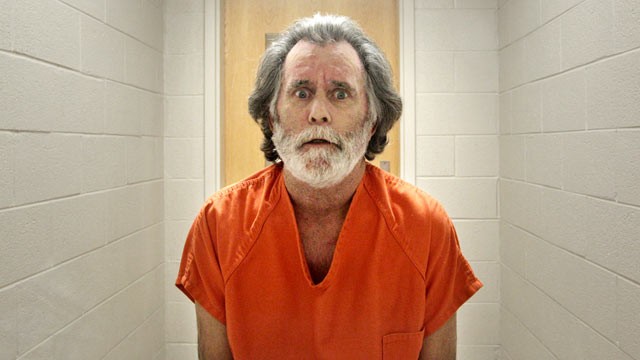
Man robs bank for $1 for health care


A video has surfaced of an American man admitting how he robbed a bank for $1 (60p) so he could go to jail and receive free medical treatment.

James Verone, of Gastonia, North Carolina, was so desperate to get help for a bad back, foot and growths on his chest that he made the calculated decision to stage the unusual robbery.

The unemployed 59-year-old, who cannot afford health insurance, told a reporter how he walked up to the cashier and handed a bizarre note demanding just one dollar from her.

The note also said he was armed, but in fact he wasn’t. The suffering man then said that he purposely sat on the couch in the RBC bank to wait for the police to arrest him.

Unfortunately for Mr Verone, because he wasn’t in possession of a weapon at the time of the robbery, the police could only charge him with larceny – a sentence that warrants a shorter jail time than that what he had initially hoped for.

Speaking from Garston County Sheriff’s Office, Mr Verone said that he had never been in trouble with the law before.

“I'm sort of a logical person and that was my logic. This is what I came up with,” explained Mr Verone.

According to the jail’s inmate handbook, inmates pay a small fee of $5 (£3) for initiated visits and declared emergency visits.

The handbook also reads: “However, no one will be denied access to health care whether they have money or not.” 

Mr Verone hoped his crime would get him a minimum of three years so he can carry on receiving free health care.

Friday, June 24, 2011

Malaysian schoolgirl rakes in $10k by selling body

Kuala Lumpur (The Star/ANN) - A secondary school student in Malaysia made 30,000 ringgit (US$9,955) during the year-end school break last year by selling her own body, Malaysian newspaper China Press reported.

It said the student from Kuala Lumpur charged customers 250 ringgit to 800 ringgit each so that she could indulge in luxury items.

"I have sex at least five times a day. However, I take a week's break each month," she told the paper.
The girl said she was cutting down on her sexual services this year as she wanted to prepare for the SPM examinations.

According to the daily, the girl was among many students who used Facebook to earn money through sex and buy luxury items they covet and one even said she had listed her sex service on a website to earn money to buy an iPhone.

Most of them were from Johor Baru, Malacca, Kuala Lumpur and Penang.

Customers are asked to pay up to 300 ringgit per session and 600 ringgit if the customer wanted an overnight sex session.

The paper reported that the girls charged 3,000 ringgit if their customers wanted to have them for a month.
It also said the girls offered telephone sex at 150 ringgit per call and sent a photograph of them in the nude through the mobile phone for 10 ringgit per copy.

The paper's reporter contacted one of the girls through SMS and Internet messaging service by posing as a customer.

Some girls, who posed as prostitutes, also used Facebook to cheat potential customers.

The paper passed on the information it had gathered on the sex service to the Johor police.

The police said they would investigate the matter.

Thursday, June 23, 2011

Ten Brands That Will Disappear in 2012


24/7 Wall St. has created a new list of brands that will disappear, which includes Sears (NASDAQ: SHLD - News), Sony Pictures (NYSE: SNE - News), American Apparel (NYSE: APP - News), Nokia (NYSE: NOK - News), Saab, A&W All-American Foods Restaurants, Soap Opera Digest, Sony Ericsson, MySpace (NYSE: NWS.A - News), and Kellogg's Corn Pops. (NYSE: K - News).

Each year, 24/7 Wall St. regularly compiles a list of brands that are going to disappear in the near-term. Last year's list proved to be prescient in many instances, predicting the demise of T-Mobile among others. In late May, AT&T (NYSE: T - News) and Deutche Telekom announced that AT&T would buy T-Mobile USA for $39 billion. The deal would add 34 million customers to the company and create the country's largest wireless operator.

Other 2010 nominees — including Blockbuster — bit the dust, while companies such as Dollar Thrifty are on the road to oblivion. Last September, after finally giving in to competition from Netflix and buckling under nearly $1 billion in debt, Blockbuster filed for Chapter 11 bankruptcy protection. In April of this year, Dish Network acquired the company for $320 million. Car rental chain Dollar Thrifty is still entertaining buyout offers from Avis and Hertz. On June 6, the embattled company recommended that its shareholders not accept Hertz's recent offer, valued at $2.24 billion, or $72 a share. Meanwhile, on June 13th, Avis Budget announced that "it had made progress in its discussion with the Federal Trade Commission regarding its potential acquisition" of the company. Although Dollar Thrifty can remain choosy, a sale is a matter of when, not if.

We also missed the mark on a few companies. Notably, Kia, Moody's, BP, and Zale appear to be doing better than we expected.

Brands that have stood the test of time for decades are falling by the wayside at an alarming rate. For instance, Pontiac, a major car brand since 1926, is gone, shut down by a struggling GM. Blockbuster is in the process of dismantling, after it once controlled the VHS and DVD markets. House & Garden folded after 106 years. It succumbed to the advertising downturn, a lot of competition, and the cost of paper and postage. Its demise echoed the 1972 shutdown of what is probably the most famous magazines in history — Life. That was a long time ago but serves to demonstrate that no brand is too big to fail if it is overwhelmed by competition, new inventions, costs, or poor management.

This year's list of The Ten Brands That Will Disappear takes a methodical approach in deciding which brand would walk the plank. The major criteria were as follows: (1) a rapid fall-off in sales and steep losses; (2) disclosures by the parent of the brand that it might go out of business; (3) rapidly rising costs that are extremely unlikely to be recouped through higher prices; (4) companies which are sold; (5) companies that go into bankruptcy; (6) firms that have lost the great majority of their customers; or (7) operations with rapidly withering market share. Each of the ten brands on the list suffer from one or more of these problems. Each of the ten will be gone, based on our definitions, within 18 months.

  • Sony Pictures
Sony has a studio production arm which has nothing to do with its core businesses of consumer electronics and gaming. Sony bought what was Columbia Tri-Star Picture in 1989 for $3.4 billion. This entertainment operation has done poorly recently. Sony's fiscal year ends in March, and for the period, revenue for the group dropped 15% to $7.2 billion and operating income fell by 10% to $466 million. Sony is in trouble. It lost $3.1 billion in its latest fiscal year on revenue of $86.5 billion. Sony's gaming system group is under siege by Microsoft (NASDAQ: MSFT - News) and Nintendo. Its consumer electronics group faces an overwhelming challenge from Apple. The company's future prospects have been further damaged by the Japan earthquake and the hack of its large PlayStation Network. CEO Howard Stringer is under pressure to do something to increase the value of Sony's shares. The only valuable asset with which he can easily part is Columbia which would attract interest from a number of large media operations. Sony Entertainment will disappear with the sale of its assets.

  • A&W
A&W Restaurants is owned by fast food holding company giant Yum! Brands (NYSE: YUM - News) which has had the firm for sale since January. There have been no buyers. The chain was founded in 1919. The size of the company grew rapidly, and immediately after WWII 450 franchises were opened. The firm pioneered the "drive in" fast food format. A&W began to sell canned versions of its sodas in 1971 — the part of the business that will survive as a container beverage business which is now owned by Dr. Pepper/Snapple. The A&W Restaurant business is too small to be viable now. It had 322 outlets in the U.S and 317 outside the U.S at the end of last year. All were operated by franchisees. By contrast, Yum!'s flagship KFC had 5,055 stores in the U.S. and 11,798 overseas. Two massive global fast food chains are even larger. Subway has 35,000 locations worldwide, and McDonald's has nearly as many. A&W does not have the ability to market itself against these chains and at least a dozen other fast food operators like Burger King. And, A&W does not have the size to efficiently handle food purchases, logistics, and transportation costs compared to competitors many times as large.

  • Saab
The first Saab car was launched in 1949 by Swedish industrial firm Svenska Aeroplan. The firm produced a series of sedans and coups, the flagship of which was the 900 series, released in 1978. About one million of these would eventually be sold. Saab's engineering reputation and the rise in its international sales attracted GM to buy half the company in 1989 and the balance in 2000. Saab's problem, which grew under the management of the world's No.1 automobile manufacturer, was that it was never more than a niche brand in an industry dominated by very large players such as Ford and Chevrolet. It did not build very inexpensive cars like VW did, or expensive sports cars as Porsche did. Saab's models were, in price and features, up against models from the world's largest car companies that sold hundreds of thousands of units each year. Saab also did not have a wide number of models to suit different budgets and driver tastes. GM decided to jettison the brand in late 2008, and the small company quickly became insolvent. Saab finally found a buyer in high-end car maker Spyker which took control of the company last year. Spyker quickly ran low on money because only 32,000 Saabs were sold in 2010. Spyker turned to Chinese industrial investors for money. Pang Da Automobile agreed to take an equity stake in the company. But, the agreement is not binding, and with a potential of global sales which are still below 50,000 a year based on manufacturing and marketing operations, and demand, Saab is no longer a financially viable brand.

  • American Apparel
The once-hip retailer reached the brink of bankruptcy earlier this year, and there is no indication that it has gained anything more than a little time with its latest financing. It currently trades as a penny stock. The company had three stores and $82 million in revenue in 2003. Those numbers reached 260 stores and $545 million in 2008. For the first quarter of this year, the retailer had net sales for the quarter of $116.1 million, a 4.7% decline over sales of $121.8 million in the same period a year ago. Comparable store sales declined 8% on a constant currency basis. American Apparel posted a net loss for the period of $21 million. Comparable store sales have flattened, which means the firm likely will continue to post losses. American Apparel is also almost certainly under gross margin pressure because of the rise in cotton prices. The retailer raised $14.9 million in April by selling shares at a discount of 43% to a group of private investors led by Canadian financier Michael Serruya and Delavaco Capital. According to Reuters, the 15.8 million shares sold represented 20.3 percent of the company's outstanding stock on March 31. That sum is not nearly enough to keep American Apparel from going the way of Borders. It is a small, under-funded player in a market with very large competitors with healthy balance sheets. It does not help matters that the company's founder and CEO, Dov Charney, has been a defendant in several lawsuits filed by former employees alleging sexual harassment.

  • Sears
The parent of Sears and Kmart — Sears Holdings — is in a lot of trouble. Total revenue dropped $341 million to $9.7 billion for the quarter which closed April 30, 2011. The company had a net loss of $170 million. Sears Holdings was created by a merger of the parents of the two chains on March 24, 2005. The operation has been a disaster ever since. The company has tried to run 4,000 stores which operate across the US and Canada. Neither Sears nor Kmart have done well recently, but Sears' domestic locations same store numbers were off 5.2% in the first quarter and Kmart's were down 1.6%. Last year domestic comparable store sales declined 1.6% in the total, with an increase at Kmart of .7% and a decline at Sears Domestic of 3.6%. New CEO Lou D'Ambrosio recently said of the last quarter that, "we also fell short on executing with excellence. We cannot control the weather or economy or government spending. But we can control how we execute and leverage the potent set of assets we have." D'Ambrosio needs to pull a rabbit out of his hat soon. Sharex are down 55% during the last five years. D'Ambrosio's only reasonable solution to the firm's financial problems is to stop supporting two brands which compete with one another and larger rivals such as Walmart (NYSE: WMT - News) and Target (NYSE: TGT - News). The cost to market two brands and maintain stores which overlap one another geographically must be in the hundreds of millions of dollars each year. Employee and supply chain costs are also gigantic. The path D'Ambrosio is likely to take is to consolidate two brand into one — keeping the better performing Kmart and shuttering Sears.

  • Sony Ericsson
Sony Ericsson was formed by the two large consumer electronics companies to market the handset offerings each had handled separately. The venture started in 2001, before the rise of the smartphone. Early in its history, it was one of the biggest handset manufacturers along with Nokia (NYSE: NOK - News), Samsung, LG, and Motorola. Sales of Sony Ericsson phones were originally helped by the popularity of other Sony portable devices like the Walkman. Sony Ericsson's product development lagged behind those of companies like Apple (NYSE: AAPL - News) and Research In Motion (NASDAQ: RIMM - News) which dominated the high end smartphone industry early. Sony Ericsson also relied on the Symbian operating system which was championed by market leader Nokia, but which it has abandoned in favor of Microsoft's Windows mobile operating system because of license costs and difficulty with programmers. In a period when smartphone sales worldwide are rising in the double digits and sales of the iPhone double year over year, Sony Ericsson's unit sales dropped from 97 million in 2008 to 43 million last year. New competitors like HTC now outsell Sony Ericsson by widening numbers. Sony Ericsson management expects several more quarters of falling sales and the company has laid off thousands of people. There have been rumors, backed by logic, that Sony will take over the operation, rebrand the handsets with its name, and market them in tandem with its PS3 consoles and VAIO PCs.

  • Kellogg's Corn Pops
The cereal business is not what is used to be, at least for products that are not considered "healthy." Among those is Kellogg's Corn Pops ready-to-eat cereal. Sales of the brand dropped 18% over the year that ended in April, down to $74 million. That puts it well behind brands like Cheerios and Frosted Flakes, each which have sales of over $200 million a year. Private label sales have also hurt sales of branded cereals. Revenues in this category were $637 million over the same April-end period. There is also profit margin pressure on Corn Pops because of the sharp increase in corn prices. Kellogg's describes the product as being "crispy, glazed, crunchy, sweet." Corn Pops also contain mono- and diglycerides, used to bind saturated fat, and BHT for freshness, which is also used in embalming fluid. None of these are likely to be what mothers want to serve their children in an age in which a healthy breakfast is more likely to be egg whites and a bowl of fresh fruit.

  • MySpace
MySpace, once the world's largest social network, died a long time ago. It will get buried soon. News Corp (NYSE: NWS - News) bought MySpace and its parent in 2005 for $580 million, which was considered inexpensive at the time based on the web property's size. MySpace held the top spot among social networks based on visitors from mid-2006 until mid-2008, according to several online research services. It was overtaken by Facebook at that point. Facebook has 700 million members worldwide now and recently passed Yahoo! (NYSE: YHOO - News) as the largest website for display advertising based on revenue. News Corp was able to get an exclusive advertising deal worth $900 million shortly after it bought the property, but that was its sales high-water mark. Its audience is currently estimated to be less that 20 million visitors in the US. Why did MySpace fall so far behind Facebook? No one knows for certain. It may be that Facebook had more attractive features for people who wanted to share their identities online. It may have been that it appealed to a younger audience which tends to spend more time online. News Corp announced in February that it would sell MySpace. There were no serious bids. Rumors surfaced recently that a buyer may take the website for $100 million. The brand is worth little if anything. A buyer is likely to kill the name and fold the subscriber base into another brand. News Corp has hinted it will close MySpace if it does not find a buyer.

  • Soap Opera Digest
The magazine's future has been ruined by two trends. The first is the number of cancellations of soap operas. Long-lived shows which include "All My Children" and "One Life to Live" have been canceled and replaced by talk shows, which are less expensive to air. The other insurmountable challenge is the wide availability of details on soap operas online. Some of the shows even have their own fan sites. News about the industry, in other words, is now distributed and no longer in one place. Soap Opera Digest's first quarter advertising pages fell 21% in the first quarter and revenue was down 18% to $4 million. In 2000, the magazine's circulation was in excess of 1.1 million readers. By 2005 it fell below 500,000 where it has remained for the last 5 years. Source Interlink Media, the magazine's parent, which also owns automotive, truck, and motorcycle publications, has little reason to support a product based on a dying industry.

  • Nokia
Nokia is dead. Shareholders are just waiting for an undertaker. The world's largest handset company has one asset. Nokia sold 25% of the global total of 428 million units sold in the first quarter. Its problem is that in the industry the company is viewed as a falling knife. Its market share in the same quarter of 2010 was nearly 31%. The arguments that Nokia will not stay independent are numerous. It has a very modest presence in the rapidly growing smartphone industry which is dominated by Apple, Research In Motion's Blackberry, HTC, and Samsung. Nokia runs the outdated Symbian operating system and is in the process of changing to Microsoft's Windows mobile OS, which has a tiny share of the market.

Nokia would be an attractive takeover target to a large extent because the cost to "buy" 25% of the global handset market would only be $22 billion based on Nokia's current market cap. Obviously, a buyer would need to pay a premium, but even $30 billion is within reach of several companies. Potential buyers would start with HTC, the fourth largest smartphone maker in the world. Its sales have doubled in both the last quarter and the last year. HTC will sell as many as 80 million handsets in 2011. The Taiwan-based company's challenge would be whether it could finance such a large deal. The other three likely bidders do not have that problem. Microsoft, which is Nokia's primary software partner, could easily buy the company and is often mentioned as a suitor. The world's largest software company recently moved further into the telecom industry though its purchase of VoIP giant Skype, which has 170 million active customers. Two other large firms have many reasons to buy Nokia. Samsung, part of one of the largest conglomerates in Korea, has publicly set a goal to be the No.1 handset company in the world by 2014. The parent company is the largest in South Korea with revenue in 2010 of $134 billion. A buyout of Nokia would launch Samsung into the position as the world's handset leader. LG Electronics, the 7th largest company in South Korea, with sales of $48 billion, is by most measures the third largest smartphone company. It has the scale and balance sheet to takeover Nokia. The only question about the Finland-based company is whether a buyer would maintain the Microsoft relationship or change to the popular Android OS to power Nokia phones.

Population growth spurs surge to Asia's cities

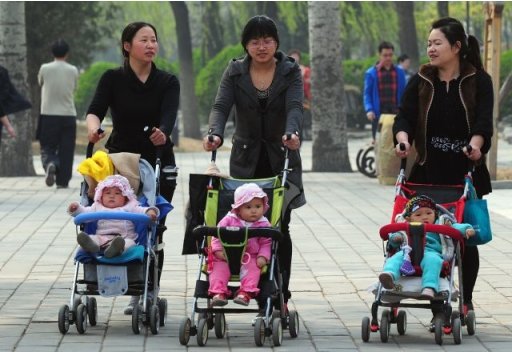
Women push babies in prams through a Beijing park during a public holiday.

Somewhere in the world -- Asia would be a good bet -- a pregnant woman is carrying a baby destined to be the planet's seven billionth human being.

The historic baby is due to be born on October 31, the United Nations Population Division predicts.

Bookmakers have made Asia the hot favourite for the symbolic arrival, possibly for no better reason than that the sun rises in the east, giving Asian mothers a head start.

If they are right, another reasonable bet would be that the baby will grow up to be part of another historic demographic shift and live in a city.

By mid-2022 there will for the first time be more people living in Asia's urban areas than in the countryside as "a tidal wave of humanity" surges towards the cities in search of jobs and a better life, the Asian Development Bank (ADB) says.

The statistics are startling:
-- About 1.1 billion people will migrate from the countryside into Asia's cities in less than 20 years, according to the ADB. That's about 137,000 every day.
-- India needs to build the equivalent of a city of Chicago every year to provide enough commercial and residential space for its migrants, according to McKinsey Global Institute (MGI) research.
-- One hundred new cities from China will join the list of the top 600 urban centres -- which generate about 60 percent of global GDP -- in the next 15 years, says MGI.

The UN's choice of which baby to dub the world's seven billionth person will be purely symbolic, given that thousands of babies are born every hour and it would be impossible to work out exactly which deserves the title.

But it is a demographic marker showing why the explosion in urban populations is so great: There are now twice as many people alive on earth as there were as recently as the 1960s.

And the six billionth child -- welcomed by former UN Secretary General Kofi Annan in Sarajevo, Bosnia on October 12 1999 -- is only 11 years old.

On the question of whether the millions heading for the cities are indeed likely to have the better life they seek, many experts are surprisingly upbeat despite the fact that humanity has never before faced such rapid urban growth.

The problems thrown up by this population explosion are huge -- from wretched slums, disease and crime to noxious pollution, overwhelmed infrastructure and crippling congestion.

But great cities have driven human development since the days of classical Athens and ancient Rome and are potent engines of social and economic development, the experts say.

"The most powerful places on the planet are cities, where knowledge and information is stored, where there is political administration, where ideas are disseminated from," Australian demographer and author Bernard Salt told AFP.

"It all comes from the frisson of having the best and the brightest coagulated together in a city environment."

Harvard professor Edward Glaeser sums up his opinion in the title of his book published this year: "Triumph of the City: How Our Greatest Invention Makes Us Richer, Smarter, Greener, Healthier, and Happier."

"In the world's poorer places, cities are expanding enormously because urban density provides the clearest path from poverty to prosperity," he writes.

But an upheaval of such magnitude will not be without its casualties.

"The transition from rural to urban does not automatically lead to middle-class prosperity, there are many that fall along the wayside," says Salt.

"This is exactly the same process that occurred in Britain during the Industrial Revolution from 1780 to 1840 -- there was tremendous human misery."

Already in Asia "cities and towns are places where poverty and disparities are most concentrated and visible", says the UN's Economic and Social Commission for Asia and the Pacific.

"Over 40 percent of Asia-Pacific's urban residents live in slums, without access to adequate shelter and basic services, income opportunities and decision-making."

The ADB points out that visitors to many Asian cities are shocked by the uncollected garbage, the traffic congestion, the beggars and the squalid living conditions of vast squatter areas.

But "the leaps made by European and American cities will likely be repeated in the developing cities of the 21st Century," Glaeser predicts.

"The urban victories over crime and disease made it possible for cities to thrive as places of pleasure as well as productivity. Urban scale makes it possible to support the fixed costs of theatres, museums and restaurants."

While city-slickers in the West may weary of the conspicuous consumption and stress of city life and, ironically, seek a less materialistic lifestyle in the countryside or on the coast, that in itself is a luxury, says Salt.

"It is an element in Western society where people say all the material goods, worldly success, it doesn't mean anything. I'm not sure people in Guangzhou or Shanghai would be pontificating about the shallowness of consumption."

Clean, efficient cities in countries such as Canada, Switzerland and Australia regularly make the top ranks of the most liveable in the world -- but critics say that does not necessarily make them the most loveable.

"I think what makes a city a desirable, exciting place to be is where there is complexity where there is richness, where there is unexpectedness -- the opposite of the calm village life," says Professor Ricky Burdett, founder of the London School of Economics' Cities Programme.

"In Asia on the whole, in China, Hong Kong, Singapore and other wealthy or more balanced states, the growth and urbanisation has come with increased quality of life," Burdett told AFP.

"I am incredibly optimistic about cities, anywhere in the world," he said, with people in cities more likely to have access to education than those in the countryside.

"If you are educated, it is the first step to everything -- it is the first step to economic and social well-being and also health."

But the seven billionth person will have a lot of people hard on his or her heels competing for that education and that job in the city -- the world's eighth billionth person is due to arrive on June 15 2025.

Wednesday, June 22, 2011

MALAYSIANS CHURN OUT 12,000 TONNES OF REFUSE DAILY


SEREMBAN, June 22 (Bernama) - Malaysians discard an estimated 12,000 tonnes of refuse a day, and that amount is expected to keep on increasing if people do not start recycling, according to the Solid Waste and Public Cleansing Management Corporation.

Chief Executive Officer Datuk Zaini Md Nor said the waste generated daily could reach 30,000 tonnes by 2020.

"Landfills are shrinking while waste is increasing by the day. If not managed well, the situation would give rise to pollution and spread of diseases," he told reporters after handing over bank account books for the Recycle Bank Programme at Sekolah Menengah Kebangsaan St Paul here today.

He said the breakdown of refuse composition showed food waste as being the highest at 45 per cent, followed by plastic, paper, metal and glass.

About 75 per cent of refuse was collected by private companies or concessionaires while 25 per cent was disposed of in other ways, including illegally into rivers or certain sites.

Zaini said that over the next three years, the corporation aimed to educate the public on the importance of taking care of the environment and improving the cleaning of drains.

The one-year Recycle Bank Programme, organised for schools in Negeri Sembilan with the cooperation of the state education department, SWM Environment Sdn Bhd and Maybank Berhad, would involve 341 primary and 127 secondary schools in the Seremban area alone.

SMK St Paul Seremban was the pioneer of the programme, which uses the principles of 3R (recycle, reuse and reduce), to encourage students to separate waste.

The programme involves students collecting recyclable waste. Proceeds of the sale would be deposited into their bank accounts as an incentive to recycle.

Tuesday, June 21, 2011

Dramatic rescue of boy trapped behind air-conditioning unit

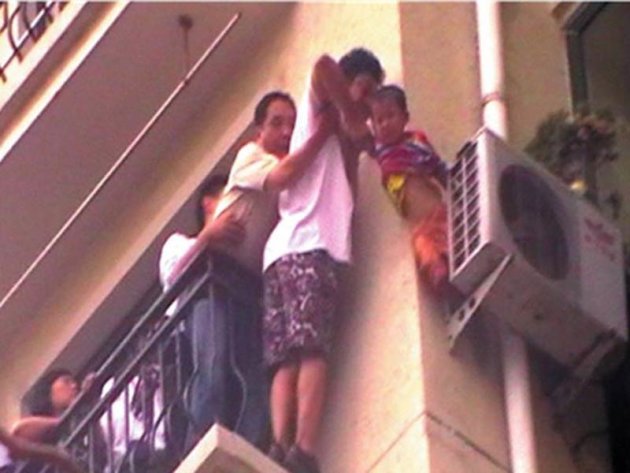
A toddler was rescued by his neighbours after he fell from a balcony and became wedged between a wall and the building’s air-conditioning unit.

The terrifying incident happened in Beijing, China, on Wednesday as the anonymous three-year-old boy was reportedly left home alone by his parents.


After plunging from the 8th floor balcony of the tall apartment complex, an air-conditioning unit fixed on the wall of the 7th floor building miraculously broke his fall.

Nearby residents were alerted to the child’s screams and found him stuck behind the unit with his legs.

According to reports, police were called but time was against them as the tiny boy started slipping through the gap.


In the amazing photos, two brave residents known as Wang and Zhou are seen pairing up to free the boy just in time.

One of the rescuers - a grocery shop worker – risks his life to climb over the balcony railings while being held on by another rescuer.


After attempting to grab the boy, he was finally plucked to safety. In the last photo, he is held up by his saviours to celebrate the dramatic rescue.

Source from: http://my.news.yahoo.com/dramatic-rescue-of-boy-trapped-behind-air-conditioning-unit-.html

Monday, June 20, 2011

Israeli court orders stoning of dog to death


Tel Aviv, June 19 (ANI): A Jewish court has reportedly pronounced a death sentence by stoning for a dog because they believed it was the reincarnation of a secular lawyer who they had cursed for insulting Jews.

The rabbinical court reportedly passed the sentence after the large dog wandered into a court in Mea Shearim neighbourhood of Jerusalem and frightened the judges.

When the dog refused to leave, one of the judges allegedly declared the lawyer's spirit must have moved into the dog as punishment, and sentenced it to death by stoning - at the hands of local children, The Daily Mail reports.

'It was ordered... as an appropriate way to "get back at" the spirit which entered the poor dog.' A court manager told the Israeli daily Yediot Aharanot.

The dog managed to escape, but an animal rights organisation, Let Animals Live, lodged a police complaint against the head of the court. (ANI)

Source from: http://my.news.yahoo.com/israeli-court-orders-stoning-dog-death-060439189.html

Ibrahim raises spectre of May 13 at anti-Bersih rally launch

KUALA LUMPUR, June 19 — Perkasa kicked off its Bersih 2.0 counter-protest here in Kampung Baru today by burning images of Bersih chairman Datuk Ambiga Sreenevasan and issuing a warning to the Chinese to stay indoors as “anything could happen”.

Perkasa Datuk Ibrahim Ali, who earlier appointed himself “war general”, said if electoral reform coalition Bersih goes through with its July 9 rally, he will not be held responsible for any untoward incidents which may occur.
“Imagine if chaos erupts. If the Bersih rally is not cancelled... I believe the Chinese community will have to stock up on food.

“Yes, anything can happen. And so I ask the police to act and use whatever powers are at their disposal,” he told some 500 supporters who gathered at Kelab Sultan Sulaiman here for the launch.

Ibrahim stressed, however, that Perkasa and the other non-governmental organisations (NGOs) opposed to the Bersih rally would not resort to violence as they were only interested in safeguarding the nation’s peace and prosperity.
But the Malay rights leader added that he would not be held responsible for the actions of those who might use the rally as a cover to commit crimes.

Ibrahim also suggested that Ambiga — described in a flyer being passed as “a dangerous Hindu woman” — was working for foreign powers seeking an excuse to interfere in Malaysia’s internal affairs.

He cited the former Bar Council president’s defence of Lina Joy’s right to convert from Islam and her involvement in the interfaith council as examples of her repeated “illegal actions”.

“Perhaps she is an agent of the Jews,” he said.

The Pasir Mas MP also repeated a claim made by Utusan Malaysia today that the opposition will use the rally to trigger an uprising similar to the ones seen in Egypt and Libya before forcing their choice of prime minister upon the people.

“If an emergency declared, will the Agong be able to appoint a caretaker leader? Maybe they (the opposition) will take to the streets and demand that they take over the government,” he said.

PR component parties and activists are gearing up to march on July 9 in the second such rally by election watchdog Bersih.

The first rally in 2007 saw up to 50,000 people take to the capital's street, before they were dispersed by police armed with tear gas and water cannon.

The 2007 rally has been credited for the PR’s record gains in Election 2008, where the opposition pact was swept to power in five states and won 82 parliamentary seats.

PAS has promised to bring some 300,000 protestors this year in hopes that it will galvanise support for the opposition in the next general election, expected to be called within a year.

Perkasa has pledged to send 20 buses from each of the 10 peninsular Malaysian states, in addition to supporters from 164 other non-governmental organisations. Umno Youth has also said it will march on July 9 to counter the Bersih rally.

Facebook users more trusting, engaged

NEW YORK (AP) — Facebook, it turns out, isn't just a waste of time. People who use it have more close friends, get more social support and report being more politically engaged than those who don't, according to a new national study on Americans and social networks.

The report comes as Facebook, Twitter and even the buttoned-up, career-oriented LinkedIn continue to engrain themselves in our daily lives and change the way we interact with friends, co-workers and long-lost high school buddies.

Released Thursday by the Pew Internet and American Life Project, the report also found that Facebook users are more trusting than their non-networked counterparts.

When accounting for all other factors — such as age, education level or race — Facebook users were 43 percent more likely than other Internet users to say that "most people can be trusted." Compared with people who don't use the Internet at all, Facebook users were three times more trusting.

The reason for this is not entirely clear. One possible explanation: People on social networks are more willing to trust others because they interact with a larger number of people in a more diverse setting, said Keith Hampton, the main author of the study and a communications professor at the University of Pennsylvania.

When all else is equal, people who use Facebook also have 9 percent more close ties in their overall social network than other Internet users. This backs an earlier report from Pew that, contrary to studies done earlier in the decade, the Internet is not linked to social isolation. Rather, it can lead to larger, more diverse social networks.

Social-networking users also scored high in political engagement. Because LinkedIn users (older, male and more educated) fall into a demographic category that's more politically active than the general population, they were most likely to vote or attend political rallies. But after adjusting for those characteristics, Facebook users, especially those who use the site multiple times a day, turned out to be more politically involved than those who don't use it.

Overall, the average American has a little more than two close confidants, 2.16 to be exact, according to the report. This is up from an average of 1.93 close ties that Americans reported having in 2008. There are also fewer lonely people: 9 percent of respondents said they had no one with whom they could discuss important matters. That's down from 12 percent in 2008.

The report didn't try to dig into cause and effect, so it's not clear whether the widening use of social networks is causing less loneliness. But it did find that people who use the Internet are less socially isolated than those who don't. Those on social networks, even less so — just 5 percent said they had no one to talk to about important stuff.

The researchers also got numbers to back up what's in the mind of many Facebook users past a certain age: Yes, all your old high school classmates really are coming out of the woodwork and "friending" you. The average Facebook user has 56 friends on the site from high school. That's far more than any other social group, including extended family, co-workers or college classmates.

Facebook's settings let users add the high school they attended to their profile, along with the year they graduated. Other users can then search for their classmates and add them as friends for a virtual reunion.
"It's really reshaping how people maintain their networks," Hampton said.

In the past, when people went to college or got jobs and moved away from their home towns, they left those relationships behind, too. This was especially true in the 1960s, when women not in the work force would move to the suburbs with their husbands and face a great deal of isolation, Hampton said.

Now, with social networks, these ties are persistent.

"Persistent and pervasive," Hampton said. "They stay with you forever."

The survey was conducted among 2,255 adults from Oct. 20 to Nov. 28, 2010. The margin of error is plus or minus 2.3 percentage points for the full sample.

Monday, June 6, 2011

'Record-breaking' chilli is hot news

The Infinity Chilli, now a record breaker.

Experts have pronounced a chilli grown in the market town of Grantham, Lincs, as the hottest in the world.

Tests have revealed the "Infinity Chilli" to have a Scoville Scale Rating of 1,176,182 - hotter than chilli reportedly used in hand grenades by the Indian military. But what is the attraction of this insanely hot ingredient?

The story of the world's hottest chilli begins not in Mexico or Bangladesh, but next to the barbed wire at RAF Cottesmore in Rutland.

Nick Woods, working shifts as an RAF security guard and considering his growing family, decided he had to do something more entrepreneurial with his life.

That was five years ago. What was Nick's hobby - cooking up hot sauces in his kitchen - developed into his Fire Foods sauce business, and now the 38-year-old Grantham man finds himself literally in possession of hot property.

Like many great discoveries Nick says he developed the Infinity Chilli accidentally.

"There are 4,000 different varieties of chilli," he explains, "and they're really easy to cross.

"I knew as soon as I saw it in the polytunnel. It stood out, and when I dissected it I could tell by the skin tissue and the seeds that it was a hot one."

Technically the chilli is not a vegetable but a fruit, from the plant genus "Capsicum".

The heat comes from the substance "capsaicin" which is found in all chillies. The attraction of it lies in the way it livens up our foods and makes the body produce pleasurable endorphins afterwards.

The chilli fire is measured by the Scoville Heat Unit (SHU) designed by American chemist Wilbur Scoville in 1912.

To put the Grantham chilli in context, a Jalapeno can score anything between 2,500 to 8,000 SHU on this scale.

The Bhut Jolokia chilli weighs in at just over 800,000 SHU. The Indian military are reported to have developed a counter-terrorism hand grenade which uses it as an ingredient to immobilise their adversaries.

But Grantham's Infinity Chilli has scored 1,176,182 SHU in a test done last year by Andrew Jukes, a scientist at the University of Warwick's Crop Centre.

  • Bigger and better
It's boom time for the chilli, because Britain's taste buds are thoroughly globalised. Many of us get used to curries and other hot snacks at college. Now the experts say we're looking for bigger and better chilli-based thrills in the kitchen.

Cookery writer Michael Michaud runs an online chilli supply firm and was responsible for the development of the "Dorset Naga", until recently one of the hottest known chillies in existence.

  • Chillies appeal to our globalised tastes
Chillies appeal to our globalised tastes.
"It's a versatile spice," he says.

"And the vast majority of British people have been eating chillies, and have been for years, because almost every high street has an Indian restaurant.

"But I think people are growing and cooking with them more. And now it's a bit like an arms race, with a macho culture going on, you know, I can eat one that's hotter, and so on.

"And trying to grow the hottest one can also get obsessive."

But the British attraction to the chilli is more than simply a yearning for the burn.

There's evidence our palates are becoming more sophisticated as our exposure to it lengthens.

"When Indian restaurants first arrived in the UK... they'd just use the one kind of chilli powder," remembers Manoj Vasaikar, head chef at the well-regarded West London chain of Indian Zing restaurants.

"Now it's much more subtle and we're using chillies with lots of different tastes and textures. We don't try to overpower the food."

  • 'Worrying'
Despite the obvious immediate discomfort - not to say total agony - that comes from eating the hottest of peppers, doctors are yet to notice any lasting ill effects from them.

In fact it's thought they could play a valuable part in pain relief and there are reports of them being used to help people undergoing chemotherapy.

Earlier this week Nick Woods decided to try one of his Infinity Chillies.

"I actually ate one yesterday. It was one I'd had frozen from last year - so I thought it wouldn't be as hot as if it was fresh - and I thought I'd try it.

"It was all a bit worrying. The burn on my tongue lasted half an hour and the effects went on and on. At one point I was doubled over in pain and thinking about ringing the hospital.

"The worst was over by 11 o'clock, but it wasn't funny."

Source from: http://www.bbc.co.uk/news/uk-12505344

Sunday, June 5, 2011

Buffalo-Born Twin Friars Die On Same Day

Julian and Adrian Riester, 92
BUFFALO, N.Y. — Identical twins Julian and Adrian Riester were born seconds apart 92 years ago. They died hours apart this week. The Buffalo-born brothers were also brothers in the Roman Catholic Order of Friars Minor. Professed friars for 65 years, they spent much of that time working together at St. Bonaventure University, doing carpentry work, gardening and driving visitors to and from the airport and around town.

"It was fun to see them, just quiet, gentle souls," Yvonne Peace, who worked at the St. Bonaventure Friary for nearly 21 years, said Friday.

They died Wednesday at St. Anthony Hospital in St. Petersburg, Fla., Brother Julian in the morning and Brother Adrian in the evening.

Both died of heart failure, said Father James Toal, guardian of St. Anthony Friary in St. Petersburg, where the inseparable twins lived since moving from western New York in 2008.

"It really is almost a poetic ending to the remarkable story of their lives," St. Bonaventure spokesman Tom Missel said. "Stunning when you hear it, but hardly surprising given that they did almost everything together."

Julian and Adrian Riester were born Jerome and Irving on March 27, 1919, to a couple who already had five daughters. They took the names of saints upon their ordination in the Catholic church.

"Dad was a doctor and he said a prayer for a boy," Adrian once said, according to St. Bonaventure. "The Lord fooled him and sent two."

After attending St. Joseph's Collegiate Institute, the brothers were turned away by the military because of their eyesight, the university said. One had a bad left eye, the other a bad right eye.

Eventually they joined the friars of Holy Name Province in New York City. They received separate assignments before reuniting at the seminary at St. Bonaventure from 1951 to 1956. After serving parishes in Buffalo for 17 years, they returned to St. Bonaventure in 1973 and spent the next 35 years there.

They had separate rooms in the friary but one telephone extension that rang into both, Peace recalled. It was usually the more talkative Adrian who answered, though Julian possessed a quiet authority. They never said who was born first.

"Brother Julian was like the big brother. Brother Adrian would defer to him," Peace said. "They picked up one of our friars at the airport one time and the friar said, `Can I take you to dinner?'

"Brother Adrian looked at Brother Julian and said, `We aren't going to dinner?' `No, we'll go home,'" Peace said. "So that was it. No discussion, no contradicting. `No, we aren't going today.'"

Funeral services are scheduled for Monday at St. Mary Our Lady of Grace Church in St. Petersburg. Afterward, the brothers' bodies will be flown to Buffalo and buried Wednesday at St. Bonaventure Cemetery, across the street from the university.

Thursday, June 2, 2011

Humorous Stories

"I made a terrible mistake" says Heir to British Throne.
Prince William Divorces Kate Middleton After 5 Weeks

LONDON — Barely a month after marrying 29-year-old Kate Middleton in a royal wedding ceremony watched by an estimated 2 billion people worldwide, Prince William announced Tuesday that he and Middleton have divorced and that the entire marriage was "a tremendous mistake in every possible regard."

"I really don't know what I was thinking — we're a terrible match, I don't love her and never have, and, to be honest, I never really had any interest in being married in the first place," announced the now unattached Prince William to a dead-silent British press corps.

"People thought our wedding was some sort of fairy tale, but I assure you it was all just some ghastly ceremonial farce that got out of hand. I'm just relieved it's over, frankly. And I'm glad I'll never have to see that awful woman again."

Prince William then told the assembled reporters, "Well, see you all later," smiled, and walked back into Buckingham Palace.


Malaysian activist to apologise 100 times on Twitter in defamation settlement

A MALAYSIAN social activist was being forced today to tweet an apology to a magazine 100 times in a bizarre defamation settlement, the Digital Journal reported.

Fahmi Fadzil agreed to the punishment after lawyers for Female Magazine took action against him in January over claims he made on Twitter. Fadzil had accused the magazine of unfairly treating his pregnant female friend, who was employed by the company.

"17/100 I've DEFAMED Blu Inc Media & Female Magazine. My tweets on their HR Policies are untrue. I retract those words & hereby apologize," his latest apology tweet said.

Fadzil agreed to spread the 100 tweets over three days, from today until Saturday.

The tweets were gaining Fadzil notoriety on his Twitter account, with many followers tweeting their support. The tweet trend #defahmi was also gaining ground Thursday, with some commentators questioning the magazine's legal move.

"They thought they got a good deal, but instead turned themselves into laughingstocks. Fahmi Fadzil, you genius #defahmi," one tweeted.

Source: news.com.au

Monday, December 6, 2010

Pokok Along

Along-along (lintah darah) suka melekatkan nombor telefon mereka pada dinding atau pintu grill dan besi di kawasan perindustrian. Sekarang, memandangkan bisnes along tidak baik, mereka melekatkan poster mereka pada pokok-pokok dan tumbuh-tumbuhan. Gambar ini telah berjaya diambil oleh saya selepas saya telah tamat waktu kerja di Ampang beberapa minggu yang lepas.

Selamat Menikmati!
Salam 1Malaysia.
"Gunakan Bahasa Kebangsaan Kita"

Tuesday, November 30, 2010

Rakyat tidak perlukan Warisan Merdeka

Dari kiri: Kuala Lumpur yang serba moden, contoh replika bangunan Warisan Merdeka, perkhidmatan broadband yang kurang memuaskan, jalan-jalan di bandar rosak, longkang monsun dan pengangkutan awam Malaysia. -GDI
Permodalan Nasional Berhad mencadangkan pembinaan bangunan mega 100 tingkat yang dinamakan sebagai Menara Warisan Merdeka yang akan menelan belanja sebanyak RM5bilion. Tapak projek adalah di tapak Stadium Merdeka dan Stadium Negara. Sekiranya projek itu bermula dalam masa terdekat, projek itu dijangka akan siap pada tahun 2015.

Semasa kepimpinan Tun Dr. Mahathir, Malaysia telah mencapai kemajuan yang tidak dapat dibayangkan oleh mana-mana kuasa besar di dunia. Kuala Lumpur telah menjadi bandar yang moden dan maju, seterusnya berkembang ke seluruh Lembah Kelang untuk membentuk bandar metropolitan (Greater Klang Valley).

Namun, kita dapat melihat dari luaran iaitu Kuala Lumpur berkembang pesat tetapi terdapat banyak perkara yang perlu dipertingkatkan supaya Kuala Lumpur boleh mempunyai daya saing dengan negara-negara membangun. Projek RM5bilion itu tidak mengubah mana-mana perkara yang akan disebut kemudian. Mengapa kerajaan tidak mengunakan duit sebanyak itu untuk membuat pernambahan infrastruktur untuk menjadikan Malaysia betul-betul maju?

Kuala Lumpur adalah sebuah bandaraya yang sibuk. Kebanyakan mereka yang berkerja akan membawa komputer riba mereka untuk meneruskan kerja mereka tanpa mengira di mana jua mereka berada. Sama ada semasa makan tengah hari, berjumpa klien dan sebagainya. Yang menyedihkan, talian internet di Kuala Lumpur dapat memenuhi kehendak orang ramai.

Kemudahan internet di Kuala Lumpur sering mengalami masalah-masalah seperti talian terputus, liputan jalur lebar yang tidak meluas, gangguan talian dan kelajuan internet yang lambat - menyebabkan ramai pengguna tidak berpuas hati dengan perkhidmatan yang diberikan. Mereka yang menggunakan jalur lebar di rumah, mereka berasa tertipu dengan iklan-iklan yang mengatakan syarikat telekomunikasi menyediakan internet jalur lebat terbaik. Namun, apa yang mereka dapat tidak setimpal dengan apa yang dibayar.

Jalan-jalan raya di kawasan Kuala Lumpur juga tidak sebaik mana. Kebanyakan jalan-jalan raya di Kuala Lumpur tidak pernah ditar semula selepas pembinaan jalan tersebut. Sekiranya jalan berlubang, pekerja dari kerajaan tempatan hanya menutup lubang sahaja. Ada jalan-jalan yang merekah hanya ditimbun dengan pasir.

Saya amat memahami sekiranya pihak Dewan Bandaraya Kuala Lumpur (DBKL) tidak dapat menutup kesemua jalan-jalan raya untuk mengtar semula, tetapi pihak DBKL boleh menutup kawasan demi kawasan untuk memperbaiki jalan-jalan yang sedia ada dari semasa ke semasa.

Longkang-longkang juga adalah salah satu daripada masalah utama di Kuala Lumpur. Sistem peparitan di Kuala Lumpur yang tidak besar dan tersumbat menyebabkan banjir. Banjir di bandar utama seperti Kuala Lumpur tidak boleh dianggap sebagai perkara biasa dan dipandang secara ringan.

Longkang-longkang dan parit-parit di Malaysia perlu diperbesarkan (diperluaskan) agar masalah banjir dapat dibendung secara serius. Untuk mengelakkan banjir daripada berlaku, longkang dan parit memainkan peranan yang sama penting seperti terowang bawah tanah dan anti banjir (SMART).

Pengangkutan awan di Kuala Lumpur wajar dipertingkatan mutu perkhidmatan masing-masing, tidak kira perkidmatan bas, teksi ataupun sistem keretapi. Pengangkutan awam merupakan sumber penting kepada para pelancong asing yang datang melawat negara kita. Kosistensi masa perjalanan pengangkutan awam kita sering dipersoal oleh pelancong-pelancong asing malah rakyat kita sendiri mengadu tentang pengangkutan awam.

Bas tidak kerap, teksi cekik darah, masalah teknikal dialami oleh sistem transit aliran ringan (LRT) dan masa ketibaan keretapi yang panjang menyebabkan kebanyakan orang hilang kepercayaan kepada sistem pengangkutan. Ramai memilih untuk menggunakan kendaraan masing-masing juga penyumbang utama kepada pencemaran udara.

Sudah tibanya masa untuk Dewan Bandaraya Kuala Lumpur untuk menjalankan kempen bumi hijau dengan melarang penggunaan plastik secara meluas seperti mana yang sedang dilakukan di Selangor dan Pulau Pinang  demi kebaikan bandaraya kita. Walaupun ianya susah untuk dilaksanakan di bandaraya ini, tetapi ia adalah  kebaikan dan juga kebersihan bandar.

Oleh itu, wang yang akan digunakan untuk projek mega itu adalah lebih baik untuk digunakan untuk meningkatan mutu perkara yang disebut di atas. Kebaikan ini dapat dimanfaatkan oleh semua pihak termasuk kerajaan kerana ianya bukan sahaja dapat menjana pertumbuhan ekonomi malahan dapat menarik lebih ramai pelancong asing untuk datang ke Kuala Lumpur. 

Wednesday, November 24, 2010

RapidKL (LRT): Offline! Tunggu pukul 4

Saya telah mendapatkan rapidpass pada 2 bulan lepas untuk digunakan untuk tujuan urusan kerja dan pada masa yang sama untuk urusan peribadi. Pada akhir bulan Oktober, saya mengalami cacar air yang telah menyebabkan saya tidak dapat ke mana-mana selama 2 minggu. 

Setelah sembuh, saya kembali bekerja seperti biasa. Tetapi, saya tidak mahu menggunakan rapidpass oleh kerana bas RapidKL jarang memasuki kawasan saya kerana tidak mahu memasuki ataupun kelewatan untuk sampai (di luar jangkauan tempoh yang ditetapkan oleh RapidKL). 

Oleh itu, saya menggunakan perkhidmatan bus dari SJ Bus yang membenarkan saya untuk sampai di Stesen LRT Maluri sebelum 8:40 pagi, melainkan berlakunya kesesakan lalu lintas yang sering berlaku di Jalan Cheras (kadang-kala terpulang kepada pemandu bas kerana ada pemandu bas yang memandu dengan cepat dan ada yang memandu seperti kura-kura).

Memandangkan kad rapidpass tidak digunakan lagi serta pembelian kad tambah nilai RapidKL LRT, saya ingin menyahaktifkan kad rapidpass. Setiap kali saya ingin menyahaktifkannya, pekerja-pekerja di kaunter di Stesen LRT Cempaka akan berkata, "Hanya kaunter sebelah (arah berlawanan) sahaja yang boleh buat." Kemudian, saya ke Stesen LRT Maluri dan mereka akan menyatakan, "Offline! Kena tunggu pukul 4."

Perkara ini berlanjutan apabila semalam, saya sekali lagi ke Stesen LRT Cempaka untuk menyahaktifkan kad rapidpass saya. Jawapan yang sama diberi, "Tunggu pukul 4."

RapidKL sudah tidak memasuki kawasan saya secara konsisten, kekerapan bas juga berkurangan, malah adakalanya tidak sampai tepat pada masa lingkungan. Sekarang, malah mahu menyahaktifkan sekeping kad juga mahu meminta saya untuk menunggu sehingga masa yang ditetapkan, pada halnya saya mahu bergeges pulang ke rumah setelah selesai kerja pada pukul 2:30 petang.

Saturday, November 20, 2010

Tahukah anda? Baju PBSM tidak boleh dipakai merata tempat?

Sebelum saya memulakan topik ini, biarkan saya memberitahu pengalaman PBSM saya. Saya menyertai PBSM secara aktif bermula dari darjah 4 sehingga Tingkatan 6 dan secara separa aktif pada dua tahun selepas tamat persekolahan. Saya memegang pengerusi PBSM sekolah selama 2 tahun (pada Tingkatan 4 dan 5) dan telah mengambil ujian lencana Pertolongan Cemas semasa Tingkatan 5. Secara tidak formal, saya bersama beberapa rakan telah dinaikkan pangkat dan saya berpangkat "Sarjan". 

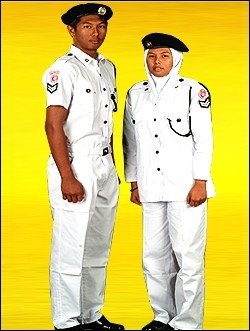
Pakaian lengkap uniform Persatuan Bulan Sabit Merah -GDI

Saya lebih mendalami aktiviti PBSM bermulanya selepas memasuki Tingkatan 1 dan mula mempelajari ilmu pertolongan cemas dan giat menjalankan aktiviti untuk PBSM. Untuk sekolah saya, PBSM-lah merupakan persatuan paling lemah dalam pertandingan kawad kaki dan sering dipandang hina oleh lain-lain ahli dari persatuan masing-masing. Walaupun setiap kali pendaftaran bermula, seramai beratusan orang menyertai PBSM tetapi pada perjumpaan, hanya 50 orang yang hadir secara aktif.

Setiap kali perjumpaan, guru penasihat kami akan mengingati kami, pentingnya peranan PBSM - sama penting dengan lain-lain persatuan yang sedia ada. Kami juga diminta untuk jangan memberi pandangan yang sama dengan PBSM dan St. John Ambulans. Guru penasihat kami merupakan seorang yang sentiasa bersama dengan PBSM, tidak kira apa jua keadaan. Beliau juga menyertai PBSM semasa bermula zaman di maktabnya. 

Kami akan ditegur sekiranya kami tidak memakai uniform ataupun kemeja-T PBSM dengan tidak elok, tidak lengkap ataupun tidak senonoh. Kami juga sering diberi amaran bahawa baju PBSM tidak boleh dipakai sesuka hati dan ke mana sahaja kerana sekiranya berlakunya kemalangan, si pemakai akan/perlu memberi pertolongan cemas (walaupun ilmu pertolongan cemas anda cetek atau tiada langsung). Semasa menghadiri kursus di peringkat daerah ataupun negeri, kami juga diberitahu bahawa baju PBSM juga tidak boleh dipakai sesuka hati. 

Namum, di zaman persekolahan sekarang, terdapat ramai orang tidak tahu perkara ini. Setiap hari Rabu, pelajar/murid dibenarkan memakai baju unit beruniform masing-masing (termasuk PBSM) ke sekolah. Adakah anda masih memakai baju PBSM anda ke pusat beli-belah, ke pusat tuisyen dan bersiar-siar? Anda perlu berhati-hati dan mendoakan agar tiada apa-apa kemalangan berlaku (tidak kira kemalangan maut ataupun kemalangan biasa - termasuk kemalangan terjatuh atau terkerat jari).

Disebabkan salah satu falsafah PBSM ialah memberi khidmat kemanusian, ia tidak terbatas kepada mereka yang sudah mahir atau professional dalam ilmu pertolongan cemas. Ahli biasa PBSM juga termaktub dalam falsafah ini. Cuba anda bayangkan sekiranya ahli keluarga anda mengalami kemalangan dan terdapat ahli PBSM berdekatan dan dia hanya melihat dari jauh. Apakah perasaan anda? 

Sekarang, ke mana sahaja kita akan kelihatan orang memakai baju PBSM (tidak kira uniform atau kemaja T). Kadang-kala saya juga berasa marah kerana sikap tidak bertanggungjawab mereka telah membuat mereka lupa bahawa setiap kali kita memakai uniform, kita kena mempunyai tanggungjawab yang tersediri - seperti anggota polis, anggota bomba, angkatan tentera mahupung ahli RELA atau pertahanan awam memakai uniform mereka masing-masing.

Sekiranya anda mahu memakai baju PBSM selain daripada pulang ke rumah, anda dinasihati untuk memakai satu lagi jaket ke tempat yang ingin dituju seperti anggota-anggota penguatkuasa memakainya selepas waktu berkerja. 

Satu nasihat umum daripada
Bekas Pengerusi Persatuan Bulan Sabit Merah
SLY-131, Tahun 2003-2004.

Saturday, November 13, 2010

Pertandingan mencipta logo

Baru-baru ini, Vectorise.net mengadakan pertandingan mencipta logo untuk laman webnya (dan laman forum). Pemenang akan menerima RM200 dan logo akan menjadi hak cipta mereka.

Tujuan saya meletakkan logo ini di laman blog saya adalah untuk meminta pandangan orang ramai sebelum saya menyerahkan salinan logo ke laman web tersebut.

Logo sebegini memang nampak semudah membina ayat. Akan tetapi, logo untuk sesuatu laman web tidak memerlukan komplikasi. Warna pula menggunakan warna asas RGB dan menambahkan 'gradient' untuk nampak lebih kemas.

Font logo pula menggunakan 2 jenis, iaitu ITC Conduit (yang digunakan oleh WWTBAM) dan Cibreo.

Saturday, September 4, 2010

5th BookFest at Kuala Lumpur Convention Center

Today, as I wanted to go to the 5th BookFest, I woke up automatically (although were because my lips were dry and painful - ulcer on the outer middle of my bottom lip). Again, I wasted an hour time during the time I woke up and preparing myself to go out.

The hand sticker is the entrance ticket and they will give you a catalog.


I took SJ Bus to go to Maluri because there was no RapidKL buses came into the end of Damai Perdana. Furthermore when still the month of Ramadhan, I’m sure that RapidKL bus drivers will be ‘lazy’ to come in (because the time also was during the afternoon.) While the bus was on the way, there was a RapidKL bus in front of the bus while I was in it.

I was a bit scared with my clothing because for the first time I wore T-shirt with a collar (and the collar need to remain stand). Of course I reached Maluri LRT station safely before I crossed over to the Maluri Bus Terminal. Then, I took RapidKL’s B114 to KLCC. I walked a long way to the Convention Center soon after I arrived in front of Suria KLCC.

In the blur mood, I went into the Convention Center without knowing where I am going to go. But there were few people came down from the escalator carried the BookFest’s plastic bag. I even asked the security guard and as where am I supposed to go? Even when I found the place, I am still confuse and looking for Steven. I was stupid enough to send SMS to him, to tell that I had reached.

When I reached Hall 1, I found that there were people wearing the red-thingy thing on their wrists. I walked around and went back to Hall 5 which only found out that I need to pay for the entrance fee. (Well! The sign at the Hall 1 was in Chinese while the one at Hall 5 was in English). I also didn’t bring so much of money with me. I checked my wallet and I only have RM10 (all in RM1 notes). The sign of the queuing lane says that “RM2 per entrance, RM10 for season pass”. I was like. “Huh? Every time I came out and in again need to cost me RM2 per entry?” When I checked the instructions in Chinese and it says that “RM2 per day and RM10 for 9-days period.”

After I get my ticket, I went back to Hall 1 for the entrance. I started to look around while looking for Steven too. Whoa! All books are in Chinese language. No English books at all. As I went down further, I saw cashiers with many people. I didn’t realize that at the side of the cashiers, there are 2 ways (at the left and right sides). When I do, I went through and saw many electronic items (with stationeries too). I have the catalog to refer but I didn’t use it. As I went to the end of it, there you are! *English books. Yet, I still can’t find Steven.

I went and round and round… At the English department’s cashier lane’s security check, I saw Steven’s brother (finally). He said that his brother is at the English department. Again, I went and check it out. Still unable to find him, I just continue to look things around.

Around 2:10p.m. I went out of the exhibition halls and try to see if I have the luck to find him or not? What I found was Steven’s brother once more and he was about to go for his lunch. He invited me to follow along and I followed him to Suria KLCC via a shortcut. We went for McDonalds’ since I don’t have much money because I forgotten to get my money.

After the lunch, we went back inside and Steven’s brother needs to get back to work. I went to English department once more to try my luck again. Thank God! Finally, I got him. He was at the children’s department. While he was working, I keep running around (not the running to be exact). When I saw him free, I will go to him and chat with him like a spy.

Oops! A picture of Steven doing his work at the BookFeast.

As time goes on, it’s nearly time to go home. I told Steven that I need to go home and hoping that I can have another day to come again. On the way home, I checked the catalog while on RapidKL’s B103 to Bukit Bintang. Only then, I saw the MOL PayPal Digital Card. I wanted it so badly when I was taking bus of U47 before changing U46 at Maluri.

I reached home and discussed it with my mother (although my mother wanted to get water bottles and she does not agree for me to get the MOL PayPal Digital Card). But, I will get it when I can have the chance to get it soon.


ShoutMix chat widget

Little Grey Rabbit in the Blogging Communities

blog malaysia: bloggers directory Komuniti Blogger Malaysia The Star R.AGE All Malaysia Info Blogger Project 大馬部落 我的部落 | 我的博客書 WWE Universe Earth Hour Who Wants To Be A Millionaire? Malaysia new RedesignMalaysia.com Blog for FT Cares! Selangor Bloggers Tweeter Malaysia
Twitter Delicious Facebook Digg Stumbleupon Favorites More

 
Design by Free WordPress Themes | Bloggerized by Lasantha - Premium Blogger Themes | Blogger Templates